


The good news is that your accountant has prepared last year's financial statements depicting your business’s performance, and it reveals a profit. But what does profit and profitability mean for your business performance?
It is easy to misconstrue profit for profitability. To understand and position your business correctly, it is crucial to understand the difference.
The Difference Between Profit & Profitability
Simply because a business earns a strong nominal profit does not mean it is highly "profitable". Many business owners expect that increased profitability is solely related to the level of sales or general activity, which is not the full picture.
Profit is an absolute figure, determined by subtracting total expenses from the total revenue.
Profitability, however, is a relative measure, determining the scope of a company’s profit in relation to the size of the business. This is primarily measured through two types of ratios: margin ratios and return ratios (see below).
Let's look at some ways of measuring business profit performance.
Profitability Margins & Ratios
Profitability ratios put these considerations into tangible, traceable figures that a business can use to track progress in relative terms over the financial year. These ratios are easy to calculate on an ongoing basis when conducting business reviews and setting objectives.
Gross Profit Margin
Gross Profit Margin divides Gross Profit (Sales less Cost of Sales) by Sales Revenue.
-
High Margin = Higher efficiency of core operations. Covering major expenses while still providing earnings to the business
-
Low Margin = A possible reflection of the general industry, higher sales volumes or some inefficiencies in processes or staffing.
Operating Profit Margin
Calculated as Earnings before Interest and Taxes divided by Revenue. It is often used to compare performance averages across an industry.
-
High Margin = The business may be better equipped than competitors to cover fixed costs and interest on obligations, and support future growth.
-
Low Margin = Can be reflective of cost overhang or gross margin performance.
Net Profit Margin
Calculated as Net Profit after Taxation divided by Revenue.
-
Benefit of this measure: all items, including tax, are considered
-
Detriment of this measure: One-off taxes and outliers are also calculated, potentially skewing data from quarter to quarter.
Let's take a look at an example.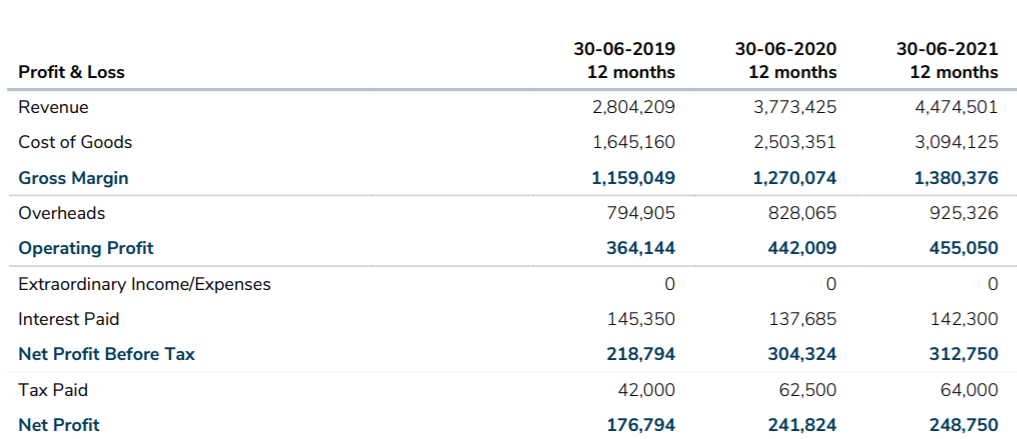
This trading business has been undergoing very strong growth in its sales over a three-year period. While initially impressive, a closer look at the ratios reveals the following:
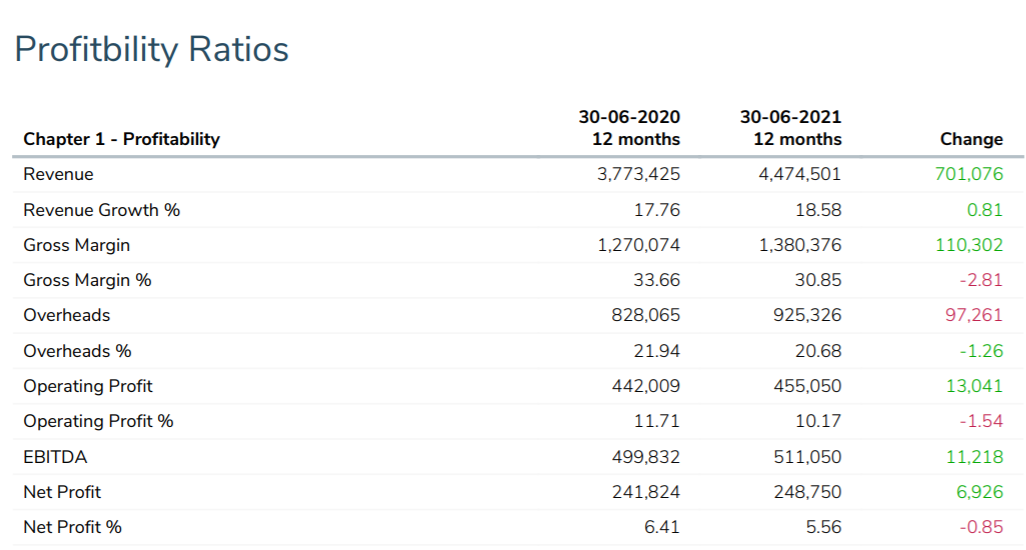
A look at the key ratios shows us that despite the nominal growth, the key Profitability Ratios or Gross Margin, Operating Profit and Net Profit are declining (as shown in red above). This means the business is working a lot harder to deliver very similar results.
This is not an uncommon story. As a business seeks growth, this can cause lower sales margins, more fixed costs, or just working harder to stretch unused capacity.
Reading the Ratios & Taking Action
In this example, the business identified the decline in profitability and set a goal to reverse the declining trends.
One excellent analytical tool is to look at what is called the "Power of One"^
This tool forecasts a 1% change in key profit drivers to see the potential impact on Profitability. 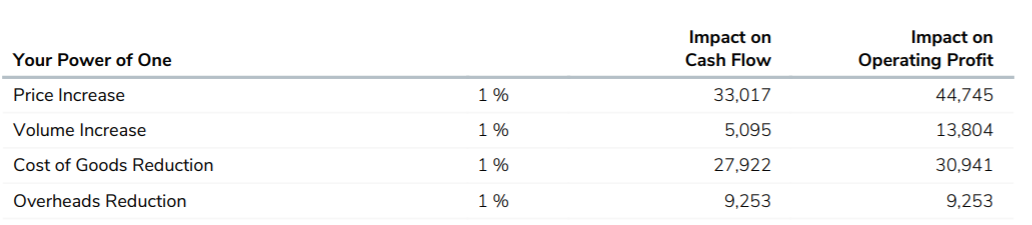
In the above example, the business could see that:
- A price increase would have a better impact on profitability than more sales volume.
- A Cost of Goods reduction has a stronger impact than reducing overheads.
Other considerations include:
-
If the price increases by 1% or more, how many customers can the business afford to lose while staying profitable?
-
What if clients are retained, and expenses increase to maintain demand?
Result
Further analysis confirmed that the business had not had a price increase for some time and that its customer service was strong. A price rise of 3% was agreed.
^ Power of One – extract from Cash Flow Story. www.mycashflowstory.com