


Updated July 2026
Many financiers have pulled out of the SMSF lending environment in recent years, casting a shadow on the validity of this strategy. The result in many cases is "orphaned" loans with increased interest rates, despite an improvement in the value of the security held by these financiers.
While there are still lenders with an appetite to review and refinance these loans to a more cost-effective interest rate, the broader question is whether it still has a role moving forward.
SMSF LENDING
Australia has over 672,800 Self Managed Superannuation Funds (SMSF) in operation, controlling nearly 1.22 Trillion in assets according to Federal Treasury data. Since it commenced in 2007, gearing via Superannuation has been popular to accelerate asset acquisition within this structure.
IS AN SMSF STRUCTURE RIGHT FOR ME?
There is a lot written about the worth of SMSFs, but the first step is to seek advice from an experienced financial adviser.
An SMSF can be fundamentally a good vehicle as it allows complete control over your superannuation. There is the flexibility to invest in assets that you generally can't do within a retail super fund, and there is also the capacity to include family - up to six members can be part of your structure.
On the flip side, there are a number of direct costs, including audit and annual reporting fees.
As a generalisation, a red flag is where people without an existing SMSF structure in place, decide to create one for the sole purpose of acquiring property and borrowing within the fund.
HOW DOES BORROWING IN AN SMSF WORK?
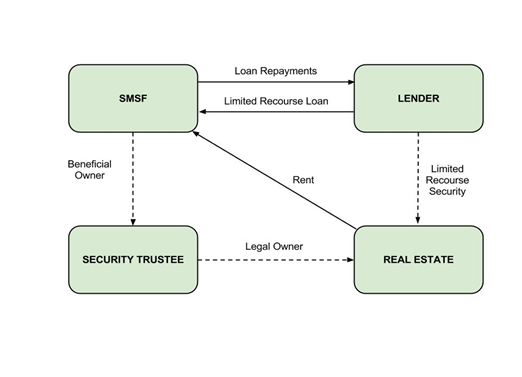
An SMSF can borrow to assist in acquiring Business Real Property. The arrangement is commonly referred to as Limited Recourse Lending.
The property being purchased is isolated in a Bare Trust or Property Trust, which will have a different trustee from the SMSF. This ensures that the assets of the SMSF are protected and there is “No Recourse” at all by the Bank to the assets of the SMSF.
SMSF BANK SUPPORT
Traditionally, this lending product was accessed by existing SMSF holders running established businesses or investment strategies. It later became a vehicle for individuals to purchase residential property, which drew the regulatory scrutiny that led to the 2026 government reforms.
Most lenders have created some good common-sense policies in place. For example, a specific requirement is that the SMSF is to hold some initial liquidity and must hold other assets outside a property being purchased.
A selection of financiers have supported lending arrangements on the following basis:
- Provide a 1st Registered Mortgage on the Security Property.
- A Guarantee and Indemnity from the Custodial Trustee.
- All Members of SMSF Trustee structures provide unsupported Personal Guarantees, limited to the loan principal, fees and charges.

OPPORTUNITY COST
It is important to consider the extra cost of borrowing using an SMSF. Typically, this would involve an interest rate premium of around 1.00% - 1.50% against borrowing "outside".
Using the example of, say, a 15-year lending term, this can be a significant interest cost premium. So the benefits (tax, etc.) need to offset this cost over the term of the loan.
THE SMSF OUTLOOK
The Association of Superannuation Funds of Australia has not historically been supportive of superannuation borrowing. There is no doubt that the availability of SMSF lending has been an influence on less experienced investors to speculate in property.
The concept of using gearing via an SMSF is still advantageous, in the right circumstances. Especially for business owners looking to own property as a separation from their operating business activities.
STRATEGY FIRST
In our view, decisions should never be made from the perspective of a taxation advantage or incentive. Before leaping into an investment in SMSF, check in on why you are doing it in the first place. Is it a good decision? If yes, the right structure for it can follow, and your SMSF could be a part of that strategy.
Lastly, with changing CGT, gearing and company tax rate policy, it is always worth keeping in mind whether it's better to invest in or outside super.
MCP's SMSF & Property Investing Guide - Edition 2, 2026 can prove a useful resource when looking to set up a SMSF for property assets. Download the guide on our Learning & Resources page.
Contact MCP
1300 510 816 or your Finance Partner
enquiry@mcpfinancial.com.au